The Chicago Heritage Inventory (CHI)
Chicago is a city of history, but who keeps that history? How do we protect it and pass it on to future generations? Do our civic policies support evolving recognition for histories past, present and future?
Location
Chicago, IL
Status
Competition Entry
Client
Horizon Lines Chicago
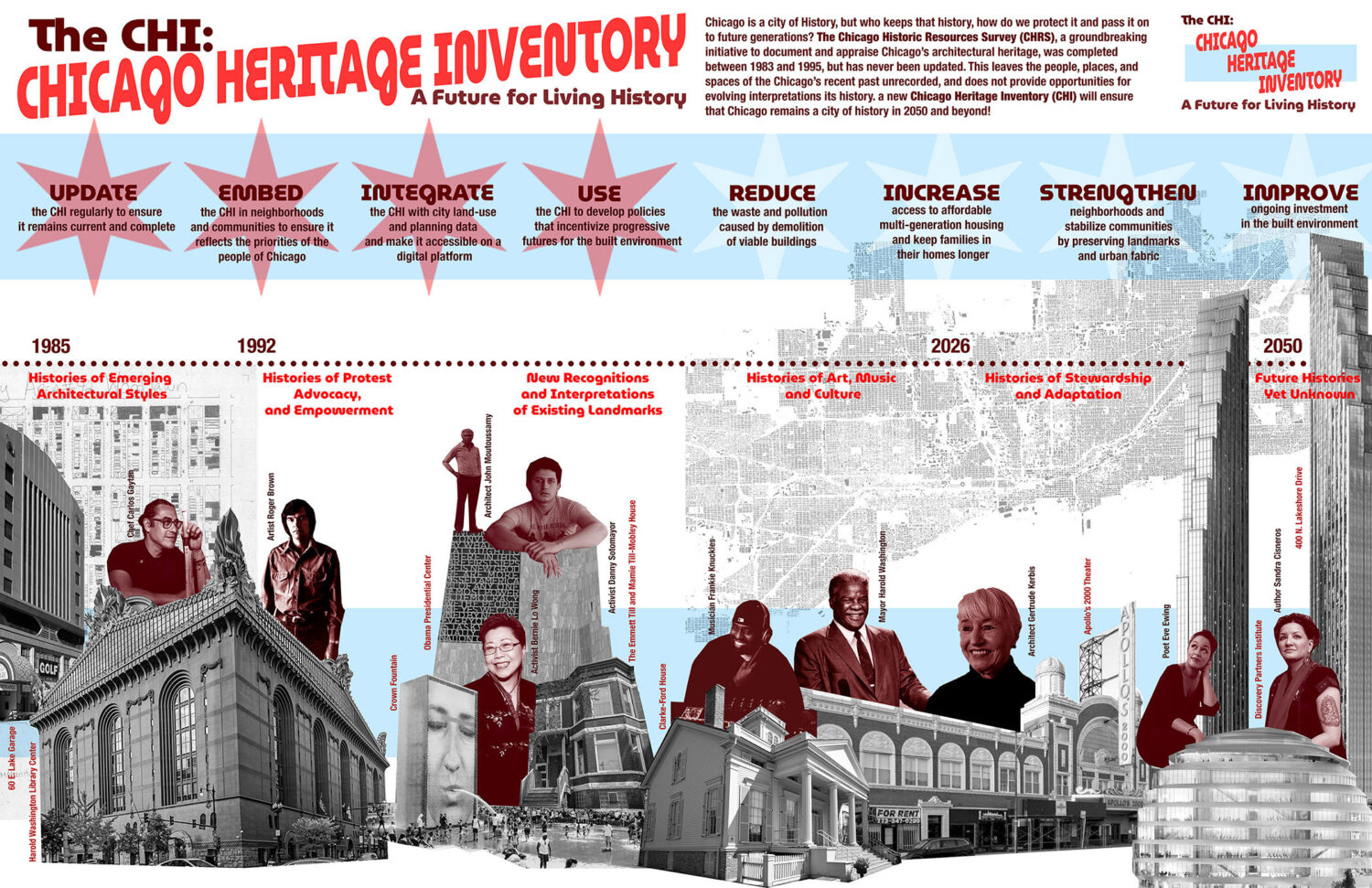
Chicago is a city of history, but who keeps that history? How do we protect it and pass it on to future generations? Do our civic policies support evolving recognition for histories past, present and future?
The Chicago Historic Resources Survey, or CHRS, a groundbreaking initiative to document and appraise Chicago’s architectural heritage, was completed between 1983 and 1995. At the time the CHRS was an innovative project, putting Chicago on the map as a leader in the field of historic preservation. CHRS surveyors identified over seventeen thousand properties that the team considered to have historic or architectural importance, researched them extensively and developed a database that included a building’s date of construction, architect, building style and type; and assessed them for a rating by color: Red, Orange, Yellow, Green, Blue, and Purple according to their age, original features, and levels of significance.
While the data was not originally intended to be used to determine what buildings have enough value to avoid demolition, it has become a crucial step in the life cycle of many viable historic buildings in Chicago. If a building does not appear in the survey as Orange or Red, it can be demolished outright without any oversight in terms of its historic or cultural significance.
Although the Commission on Chicago Landmarks is obligated by the 1966 Chicago Landmarks Ordinance to revise the survey regularly, it has never been updated; but the city has grown and evolved. Chicago in 2026 is a city of almost a half a million buildings and parcels. CHRS’s forty-year-old data covers only seventeen thousand properties—roughly 3% of that inventory. Buildings and places that were built after 1940, or were the site of a historic event but without architectural significance, were largely left out of the survey. As a result it does not record certain major architectural styles, like midcentury modernism; nor places associated with historical events, such as the civil rights movement.
Across the twelve-year CHRS research effort and since, history has continued to be made in Chicago. During that time, Chicago elected its first African American mayor, Harold Washington. DJ Freddie Knuckles captured Chicago’s colorful melting pot through the creation of a new musical style that would come to be known as House. Chicago Imagist painter Roger Brown created works inspired by Chicago and American pop culture. Activists like Danny Sotomayor confronted the HIV/AIDS crisis with creativity and grit. Architects like John Moutoussamy and Gertrude Kerbis broke the gender and color barriers that dictated who could be an architect, and Stanley Tigerman and Helmut Jahn designed imaginative buildings that would come to define Chicago’s relentless creative reach towards the 21st Century. Meanwhile, new interpretations of history brought vernacular buildings and their cultural importance to the forefront, including the boyhood home of Emmett Till, a modest brick two flat. Even existing landmarks have ongoing and intersecting histories, including the stories of stewards like The Galindo Family, the longtime owners of Apollos 2000, and Bishop Louis Henry Ford, who saved the Henry B. Clarke House from demolition, and was added to the house’s name in 2021.
The CHRS contains none of these important stories, nor does it provide opportunities for future histories to be recognized.
It is time for Chicago to be a leader once more by launching the Chicago Heritage Inventory, or CHI, an initiative to resurvey Chicago’s historic places and spaces and record them in an accessible public database that provides information on historic resources, guides long-range planning decisions, informs project review, and supports policy goals that ensure Chicago remains a city of living history.
History is contentious. Instead of being reactive, a living survey would proactively engage communities over how history is interpreted and presented in the city.
History is a continually moving thing. Things that were new in 1985 are over forty years old today. In order to preserve the city’s history, we have to plan for the future and act, continually, in the present.
History continues to be interpreted. In 1985, the team preparing the Chicago Historic Resources Survey worked hard to make it thorough and complete, but in the time since they completed their work, new understandings of history have emerged.
History requires full participation. A survey that does not involve participation by living communities risks leaving out significant parts of their stories.